TMJ Pain Treatment

Pain Relief for TMJ in Burlington, ON
Introduction
Pain in the jaw, difficulty with opening the mouth or chewing, an ear-ache, and jaw clicking/locking are common symptoms of a “TMJ problem” or dysfunction. The temporomandibular joint (TMJ) is a complicated joint and it plays a very important part in our everyday functions like chewing, talking, yawning and even breathing.
In this blog we’ll cover the following subjects along with options for TMJ pain treatment.
- The anatomy of the TMJ and how it works
- What causes the pain
- Treatment approaches including chiropractic care and acupuncture
- Self-treatment / habits that can be applied at home
- A downloadable printable PDF summary of the key information (see bottom)
Anatomy of the TMJ
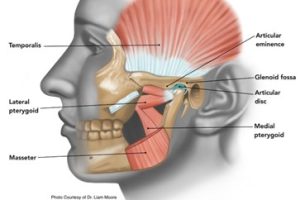
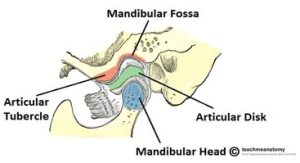
The temporomandibular joint, or TMJ is a small hinge joint that connects the lower jaw (also known as the mandible) to the skull (the temporal bone). We have one joint on each side of our head and they are located directly in front of our ears. These joints and their surrounding muscles work together to allow us to talk, chew, swallow or yawn.
Main parts of the TMJ:
- Mandibular Condyle/Head- the rounded top part of the lower jaw bone
- Mandibular Fossa- a small hollow space in the skull where the mandibular condyle fits
- The disc- this is a small piece of cartilage that is located between the condyle and the fossa. Its purpose is to provide cushion for the joints and to help with smooth movement
- Muscles of Mastication- these are the main jaw muscles that make movement possible. The main muscles are:
- Masseter and Temporalis: they close the jaw such as when we bite down
- Medial and Lateral Pterygoids: these help with side to side movements as well as forwards and backwards movements.
How the Joint Moves:
The TMJ is special because unlike most of our other joints, it does two types of movements:
- Hinging- this is simply opening and closing of the jaw
- Gliding- this is when the lower jaw slides forward and backward as we open wider
When we combine these two movements, we are able to chew and talk without any problems. However, if there are difficulties or dysfunctions in these joints with these movements (usually due to a muscles or disc problem), it can lead to problems such as pain, clicking, locking and stiffness.
It is also important to note that the jaw is closely connected to our teeth and our neck posture. This is why treatment is not focused on just the jaw but also all the muscles around the jaw (including those in the neck, face and head).
What causes TMJ pain and Dysfunction?
There are many reasons why this joint can cause us so much discomfort (https://tmj.org/living-with-tmj/basics/).
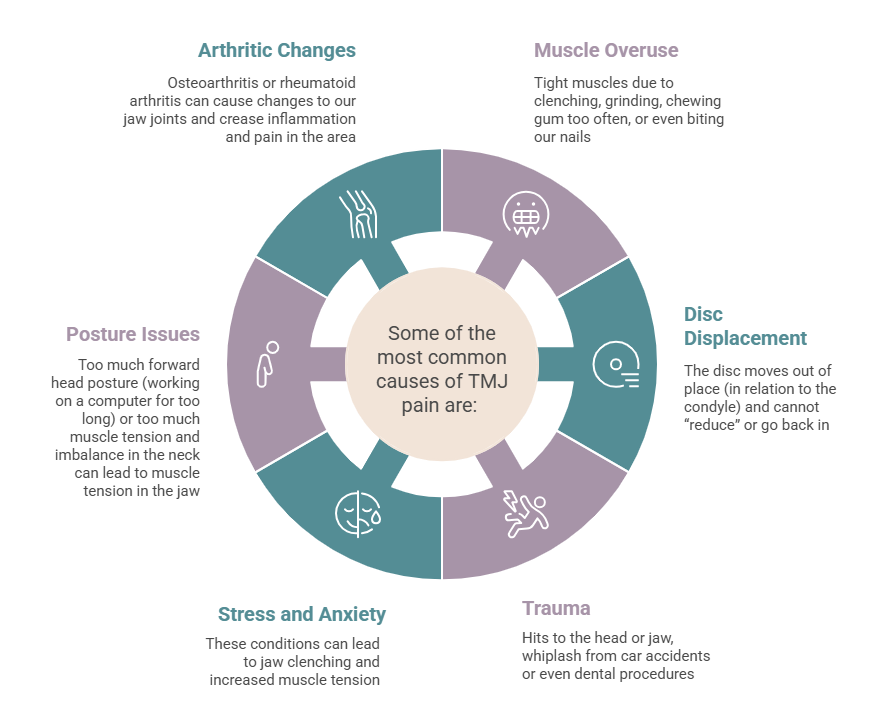
Some of the most common causes of TMJ pain are:
- Muslce overuse- muscles can become too tight due to clenching, grinding, chewing gum too often, or even biting our nails
- Disc displacement- this happens when the disc moves out of place (in relation to the condyle) and cannot “reduce” or go back in
- Trauma-this includes hits to the head or jaw, whiplash from car accidents or even dental procedures
- Stress and anxiety- these conditions can lead to jaw clenching and increased muscle tension
- Posture and neck alignment- too much forward head posture (such as when working on a computer for too long) or too much muscle tension and imbalance in the neck can lead to muscle tension in the jaw
- Arthritic changes- osteoarthritis or rheumatoid arthritis can cause changes to our jaw joints and crease inflammation and pain in the area
The mechanism of injury (how the joint becomes painful):
There are many reasons for pain but the most common ones include muscle tension, disc displacement, joint degeneration, and nerve irritation. Then it comes to muscle tension, overly tight muscles can cause spasms and pain. With disc displacement or joint degeneration, the joint is no longer working smoothly which causes abnormal rubbing and inflammation in all the surrounding tissues. This inflammation can be very painful and can also affect the surrounding nerves. When nerves are irritated, the patient can start to feel pain in their ear, temple and neck.
Patients who have TMJ pain often have secondary related symptoms such as headaches, dizziness, ear-ringing and neck pain.

It is important to recognize the signs and symptoms of TMJ dysfunction because more chronic conditions can be more difficult to reverse. Early treatment improves the chances of a full recovery.
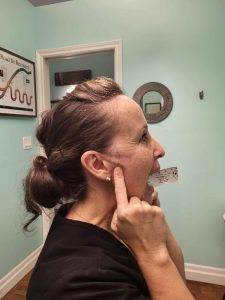
This is an illustration of Doctor Maja measuring how wide she can open her jaw. These measurements are taken before and after treatment to compare progress.
TMJ Pain Treatment
There are many treatment options but some of the more standard and common treatments include:
- Physical Therapy: this includes any type of manual therapy (such as chiropractic, massage, physiotherapy, acupuncture) and usually involves the use of soft tissue and muscle massage, joint mobilizations, insertion of thin acupuncture needles to reduce inflammation and improve blood flow, jaw exercises and posture correction. At Edgar Family Chiropractic, our doctors have experience and expertise in treating the TMJ. We will cover the details of what this entails in the section below.
- Lifestyle/diet changes: this includes avoiding hard or chewy foods (such as apples or gum)
- Dental bite splints or night guards for grinding
- Medications- sometimes conservative treatment is not always possible until inflammation and spasm is brought down. In this case, patients would be prescribed NSAIDS and muscle relaxants by their family doctor or specialist
- Injection therapy- once again, in cases where conservative care is not possible or not working, steroid injections or injections of Botox can help
- Surgical interventions – in cases where all other interventions fail and for severe joint damage that is not responding to conservative treatments, surgical procedures could be recommended.
Chiropractic and Acupuncture Care for TMJ
Research is showing that Chiropractic Care and Acupuncture is a great option for multi-disciplinary management of TMJ pain and dysfunction.
In a study done in 2022 by Dunning J, Butts R, Bliton P et al. and titled “Dry needling and upper cervical spinal manipulation in patients with temporomandibular disorder: A multi-center randomized clinical trial” it was shown that “The combination of dry needling and upper cervical spinal manipulation resulted in significantly greater improvements in jaw pain intensity and active pain-free mouth opening than a combination of interocclusal splint therapy, NSAIDs, and non-thrust joint mobilization to the TMJ”.
(Reference: Dunning J, Butts R, Bliton P et al. Dry needling and upper cervical spinal manipulation in patients with temporomandibular disorder: A multi-center randomized clinical trial. Cranio 2022 Apr 12: 1-14. doi: 10.1080/08869634.2022.2062137z)
How do we treat the jaw with chiropractic and acupuncture care:
At Edgar Family Chiropractic, our doctors have experience and expertise in treating TMJ dysfunctions with a multi-modal approach that includes some of the following:
- Jaw and TMJ adjustments and mobilizations- these are gentle, precise movements that help to improve joint mobility and align the jaw properly
- Muscle therapy and release- releasing tension in the muscles around the jaw, face, neck and shoulders
- Intra-oral muscle release and trigger point therapy- our doctors are trained in orofacial therapy and work on muscles inside the mouth to release and relax them
- Cervical spine alignment- since the jaw is closely related to neck posture, it is important that we address the muscles and the joints of the neck to make sure they are working properly and not impeding the function of the jaw.
- Acupuncture- thin needles as inserted at specific acupuncture points ( in the face, jaw and neck) in order to reduce muscle tension, improve circulation, and reduce pain. A recent randomized control study of acupuncture versus sham treatment found that real acupuncture produced significantly greater pain relief for TMJ myofascial pain (https://pubmed.ncbi.nlm.nih.gov/17095133/)
Case Study: 42 year old woman came into the clinic complaining of ringing in her ears, new onset of headaches and right sided neck and jaw discomfort. After a thorough history to determine if there are any red flags and a physical and neurological exam, it was determined that she had right sided TMJ dysfunction and cervical postural dysfunctions (imbalances in the muscles and joints of her neck). A trial of treatment was started consisting of muscle therapy and gentle mobilizations on the neck and shoulders, trigger point therapy on the jaw both internally and externally, acupuncture in the muscles of the jaw and finally stretches and exercises for her neck and jaw were prescribed. After four treatments at once per week, patient was reporting less ringing in her ear and no pain in her neck and jaw. Headaches were reduced from 3 times per week to once every other week.
When looking for a treatment provider, make sure to look for a chiropractor with TMJ specialization or training as well as one that is also a licensed /accredited acupuncturist. Treatment tends to be more effective when there is a combination of treatments (chiropractic mobilizations, muscle therapy, acupuncture, exercise prescription). Treatment is also more effective when combined with self-care strategies which we will address in our next section.
Self-Treatment and Daily Habits
Here are some home strategies what will complement the chiropractic and acupuncture care as well as help prevent future episodes of pain:
- Stick to softer food when having a flare-up such as yogurts, smoothies, soups, mashed potato and soft eggs. Avoid hard and crunchy foods such as apples, tough meat, raw carrots.
- Avoid gum chewing, biting your nails, clenching during workouts, stomach sleeping
- Relaxation exercise: let your tongue rest gently on the roof of your mouth, lips lightly together, teeth slightly apart and then gently open and close and move the jaw right-left
- Resisted exercise: put your fingers under your chin, open the mouth slowly while gently resisting with the fingers (repeat 5-10 times)
- Relaxing the neck and upper back: do gentle chin tucks and shoulder blade squeezes to help improve posture and take pressure off the jaw
- Heat pack: apply a warm heat pack to the side of the jaw for 10-15 minutes. Use a combination of ice and heat if the jaw feels warm and inflamed.
- Manage Stress: consider meditation, , deep-breathing or gentle yoga.
- Sleep posture: avoid sleeping with too many pillows and try sleeping on your back with a supportive pillow; if you notice that you are grinding or clenching at night, ask your dentist about a night-guard.
If you have pain that is not going away, difficulty eating, headaches or ear pain, trauma to face or jaw, jaw-locking/clicking/popping and have done self-care strategies for 1 week without improvements or with worsening symptoms, it is time to see a professional for some help.