Low Back Pain Treatment in Burlington, ON
Learn what may be causing your low back pain, which treatments can help, and what steps you can take to feel better.

Introduction
Low back pain is one of the most reasons why people see their doctor, miss work, and reduce their activity. It affects people of all ages, from teenagers to older adults, and can range from a mild, nagging ache to severe pain that limits daily function. For many people, low back pain can be very scary especially when it interferes with work, exercise, sleep, or daily life.
The good new is that the majority of low back pain is not caused by serious disease or permanent damage. Most cases of low back pain improve with conservative care (such as physical therapy or chiropractic), appropriate movement, and simple lifestyle adjustments. Understanding how the low back works, why pain develops, and what you can do about it is one of the most powerful tools for recovery.
In this blog we’ll cover:
- The anatomy of the low back and how it works
- What causes the pain
- Treatment approaches including chiropractic care, acupuncture, and massage therapy
- Self-treatment / habits that can be applied at home
A downloadable printable PDF summary of the key information (see bottom)
Anatomy of the low back
The low back is a complex system of bones, discs, joints and cartilage, ligaments, and muscles. It must be strong enough to handle significant loads and also flexible enough to bend, twist, and rotate.
Key Structures of the Lumbar Spine
Lumbar Vertebrae (L1–L5)
These five bones or “vertebrae” form the lower portion of the spine. They are designed to bear weight and absorb forces from lifting, walking, and daily activities.
Intervertebral Discs
Located between each vertebra, discs act as shock absorbers. Each disc has a tough outer ring (annulus fibrosus) and a gel-like center (nucleus pulposus). Discs allow movement while distributing pressure across the spine.
Facet Joints
Facet joints are small joints at the back of the spine that guide motion and provide stability. When irritated or stiff, they can be responsible for many cases of low back pain.
Muscles and Tendons
The low back relies on both deep stabilizing muscles (such as the multifidus and transverse abdominis) and larger surface muscles (erector spinae, quadratus lumborum, and gluteals). These muscles work together to support posture and movement.
Ligaments
Ligaments connect bones and provide passive stability to the spine, especially at the end ranges of motion.
Nerves
Nerve roots exit the lumbar spine and travel into the hips, legs, and feet. Irritation of these nerves can lead to symptoms such as numbness, tingling, or radiating leg pain (often known as “Sciatica”).


When the above structures move well and share load appropriately, the low back functions well without pain. Pain often develops when one or more components are overloaded, stiff, weak, or not functioning well.
What Causes Low Back Pain and Dysfunction
Low back pain is rarely caused by a single event or structure. Instead, it usually results from a combination of mechanical, physical, and lifestyle factors (https://www.mayoclinichealthsystem.org/hometown-health/speaking-of-health/not-all-low-back-pain-is-the-same)
Common Contributors to Low Back Pain
Poor Posture and Prolonged Sitting
Longer periods of sitting—especially with slouched posture—can increase the stress on discs, joints, ligaments and muscles. Over time, this can reduce how much the spine can tolerate everyday loads.
Muscle Weakness and Imbalances
Weak core and glute muscles can force the low back muscles, joints, and discs to do more work than they should. This often leads to fatigue, strain, and chronic pain.
Reduced Mobility
Stiffness and tightness in the hips or limited movement and flexibility in the thoracic (mid-back) spine can cause the lumbar spine to compensate. This can cause increased irritation in the low back.
Repetitive Strain
Frequent bending, twisting, lifting, or prolonged static positions (long periods of sitting/standing)—especially without enough recovery—can gradually overload the back.
Sudden Overload or Injury
Trauma (like a sports injury, work injury or motor vehicle accident), lifting a heavy object, slipping, or an awkward movement can trigger an acute episode of low back pain.
Disc Changes and Degeneration
Age-related changes such as disc bulges or degeneration of the discs are common reasons why patients can experience pain.
Stress and Psychosocial Factors
Stress, poor sleep, anxiety, and fear of movement can increase muscle tension and pain sensitivity, prolonging recovery.
It is important to note that most low back pain is classified as “non-specific,” meaning no single structural cause can be identified and pain can be multi-factorial. This means that treatment will also have to be multi-factorial addressing pain, inflammation, all involved structures of the back (muscles, ligaments, joints, nerves), as well as lifestyle choices (such as exercise, nutrition and stress).
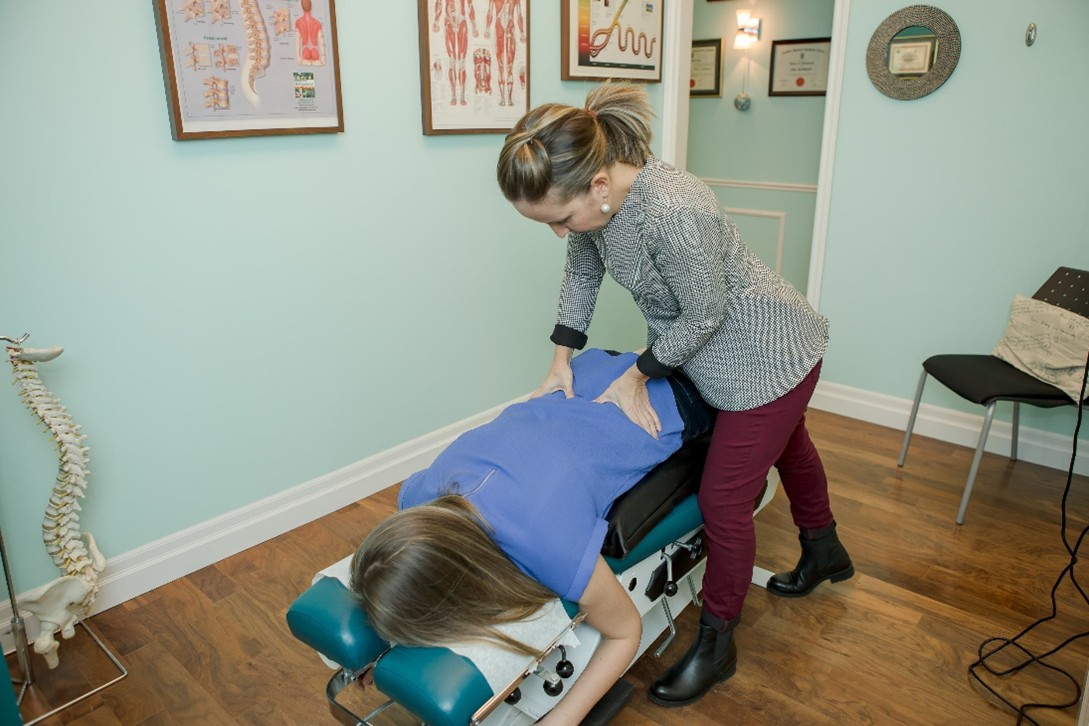
This is Dr. Maja Edgar assessing and treating a patient with low back pain.
Treatment
Conservative, non-invasive care is the first-line approach for most low back pain and is highly effective for the majority of people.
Evidence-Based Treatment Options:
Chiropractic and Acupuncture
Hands-on care as well as needling can help reduce pain and inflammation, restore joint mobility, reduce muscle stiffness, and improve function.
Physiotherapy
Physiotherapy focuses on improving strength, flexibility, coordination, and confidence with movement. Individualized exercise and rehabilitation programs are central to long-term recovery.
Massage Therapy
Massage can reduce muscle tension, improve circulation, and help calm the nervous system.
Exercise Therapy and Rehabilitation
Targeted strengthening of the core, hips, and legs improves spinal support and resilience. Gradual loading helps the tissues adapt and become more tolerant to daily stress.
Education and Reassurance
Understanding that movement is safe and beneficial reduces fear and promotes faster recovery.
Activity Modification
Temporary adjustments—rather than complete rest—allow healing while maintaining fitness and confidence. Bed rest is rarely recommended. Staying active within tolerable limits leads to better outcomes.
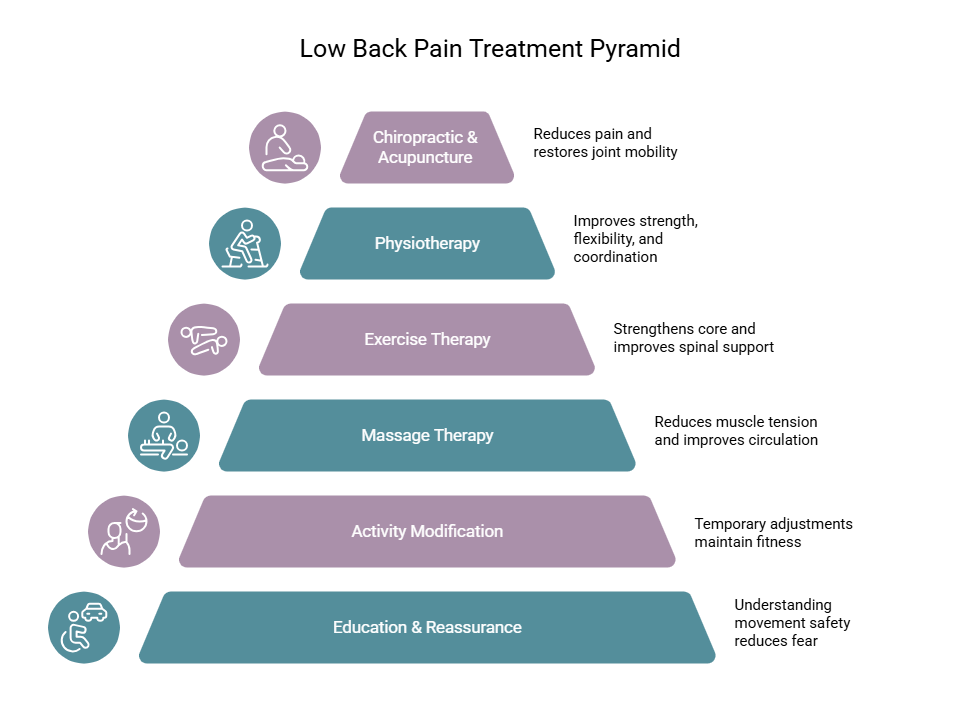
Chiropractic and Acupuncture Care for Low Back Pain
Research is showing that Chiropractic Care is a great option for multi-disciplinary management of low back pain and dysfunction.
In a study done in 2016 by Globe G, Farabaugh RJ, Hawk C, et al.and titled “Clinical Practice Guidelines: Chiropractic Care for Low Back Pain” it was shown that “Chiropractic care is considered quite safe and effective compared to common medical treatments or procedures.” It also indicated that “Chiropractors are competent at many approaches to functional assessment and treatment, and depending on clinical complexity, can function independently or as part of a multidisciplinary team. The overarching goal of chiropractic care is to improve the functional capacity of a patient, while educating them to accept responsibility for their own health.”
(Reference: Globe G, Farabaugh RJ, Hawk C, et al.and titled “Clinical Practice Guidelines: Chiropractic Care for Low Back Pain” Journal of Manipulative & Physiological Therapeutics 2016; 39(1): 1-22. doi: 10.1016/j.jmpt.2015.10.006.)
How do we treat the low back with chiropractic and acupuncture care:
At Edgar Family Chiropractic, our doctors have experience and expertise in treating low back pain and dysfunctions with a multi-modal approach. This kind of approach is supported by research as the best approach to resolving low back pain. It includes some of the following:
- – Low back adjustments and mobilizations- these are gentle, precise movements that help to improve joint mobility
- – Muscle therapy and release- releasing tension in the muscles in and around the low back (including gluteal and hip muscles)
- – Acupuncture- thin needles as inserted at specific acupuncture points (in the low back and hips) in order to reduce muscle tension, improve circulation, and reduce pain
- – Physiotherapy Modalities- modalities such as interferential current (IFC), ultrasound, TENS, ice/heat are used to reduce pain, improve circulation, and reduce inflammation.
- – Exercise and Lifestyle Modifications- patients are given stretches and exercises to strengthen weakened muscles and to improve core strength. They are also given advice on activities to avoid while healing and ideas on how to modify certain movements in the long run. These modifications help to reduce the frequency of a potential re-occurrence.
Case Study: 30-year-old woman came into the clinic complaining of low back pain and left sided leg pain that is getting worse. She could not recall what started the pain but indicated that she was shoveling snow a few days ago. After a thorough history to determine if there are any red flags and a physical and neurological exam, it was determined that she left sided low back dysfunction and possible compression of the sciatic nerve that is causing pain and weakness in her left leg. A trial of treatment was started consisting of muscle therapy and gentle mobilizations on the low back and hip, ultrasound therapy on the low back to reduce inflammation of the exiting sciatic nerve and muscles surround it, acupuncture in the muscles of the low back, hip and leg (following the course of the sciatic nerve) and finally stretches and exercises were prescribed. Patient was also advised on what movements to avoid. After six treatments at twice per week, patient was reporting no leg pain and minimal low back pain.
When looking for a treatment provider, make sure to look for a qualified and trained chiropractor as well as one that is also a licensed /accredited acupuncturist. Treatment tends to be more effective when there is a combination of treatments (chiropractic mobilizations, muscle therapy, acupuncture, exercise prescription). Treatment is also more effective when combined with self-care strategies which we will address in our next section.
Self-Treatment Strategies
Active self-care plays a major role in both recovery and prevention.
Gentle Movements are Key
Walking, light stretching, and mobility exercises keep the spine moving and reduces stiffness.
Heat or Ice
Heat can help relax tight muscles and reduce stiffness. Ice may be helpful during the initial stages of an acute flare-up when there is a lot of inflammation.
Core Activation Exercises
Simple exercises such as pelvic tilts, bridges, bird dogs, and dead bugs help to strengthen the muscles that support the spinal joints and discs, providing relief to these structures.
Hip and Leg Mobility
Stretching the hip and leg muscles such as the hip flexors, hamstrings, and glute muscles reduces stress on the low back.
Daily Habits That Protect Your Low Back:
To keep your spine feeling good in the long run and to avoid chronic pain, it is important to maintain good daily habits.
Move Often
Take breaks from sitting every 30–60 minutes. Even short movement breaks(2-3 minutes) make a difference.
Lifting Posture
Keep objects close to your body, hinge at the hips, and avoid twisting while lifting.
Maintain Physical Activity
Regular walking, strength training, and mobility work help to maintain a strong spine.
Optimize Sleep
Finding a comfortable sleeping position and a supportive mattress and pillow are very important in order to allow the spine to get proper rest.
Manage Stress
Breathing exercises, mindfulness, and relaxation techniques can change the way we perceive pain and can decrease muscle tension.
When to Seek Professional Care
Some back pain resolves on its own with the help of the above-mentioned strategies. However, sometimes professional evaluation is recommended if pain:
- Persists longer than a week
- Is progressively worsening
- Radiates down the leg with numbness or weakness
- Interferes significantly with activities of daily living or sleep
Early treatment can also prevent acute pain from becoming a chronic problem.
Download Our Low Back Pain Relief Guide
Get a clear, easy-to-follow guide to understanding low back pain, what may be causing it, and what you can do at home to feel better. This downloadable resource includes simple relief strategies, movement tips, daily habits to support your back, and important signs that it may be time to seek professional care.